Ira J. Allen is Associate Professor of Rhetoric, Writing, and Digital Media Studies in the Departments of English, Politics, and International Affairs at Northern Arizona University. His book, Panic Now? Tools for Humanizing, argues that the steadily worsening ecological situation demands a more assertive response than hope and optimism can provoke. It calls, instead, for a wiser sort of panic.
By 1988, the climate problem had become serious enough to prompt Dr. James Hansen’s testimony before Congress, the formal establishment of the Intergovernmental Panel on Climate Change, and a new, bipartisan campaign issue with then-candidate George H. W. Bush promising to counter the greenhouse effect with the “White House effect.” However, by 1992 then-President Bush had balked at his commitment, spurning the Rio “Earth Summit,” and announcing that “the American way of life is not up for negotiations” (5-6). Since then, the history of international cooperation on climate change has largely honored this precedent. The world’s governments are represented at periodic “Conferences of the Parties,” where protocols are signed and a lot of (probably) good faith pledges are made but where consensus always shrivels before any real negotiation of a carbon-intensive way of life. If anything, the three decades between the adoption of the United Nations Framework on Climate Change in Rio and the passage of the Inflation Reduction Act in Washington, D.C. have been defined, not by the global drawdown of greenhouse gas emissions or the greening of the economy so much as the precise opposite, as even advances in efficiency have been absorbed within a “Great Acceleration” of economic growth and its noxious effects—climate change, habitat destruction, mass extinction, microplastics, and all the rest.
Is it time to panic?
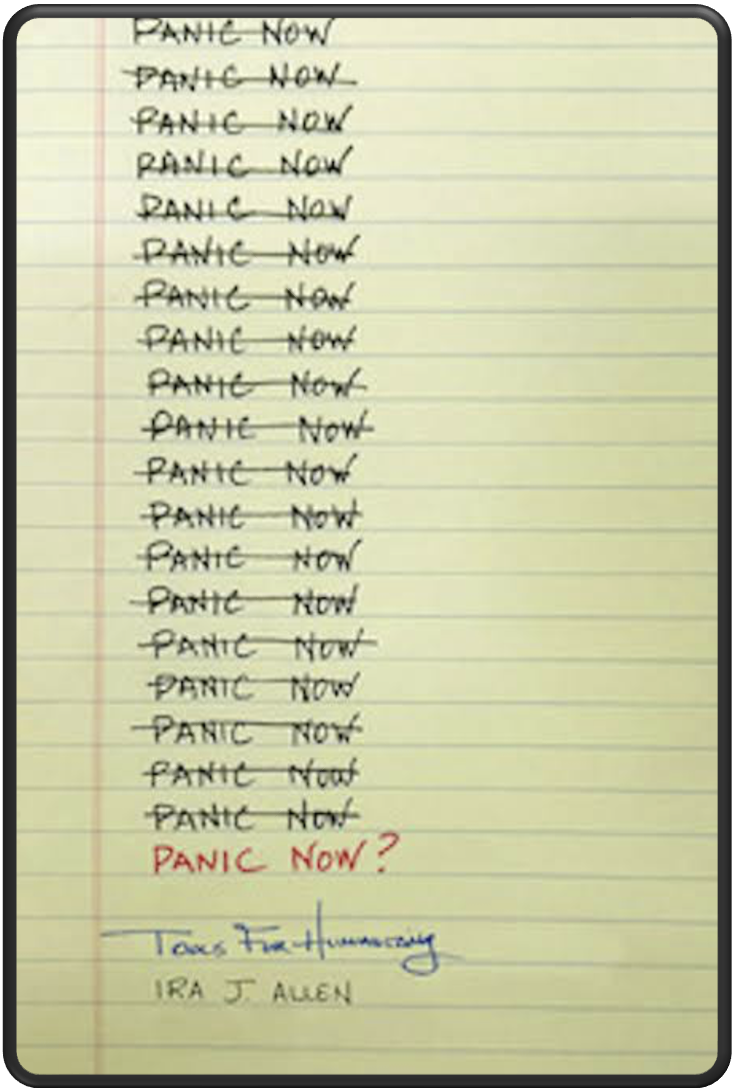
If our answer is a reflexive no, then we should consider the possibility that this is a conditioned response to a merely “rhetorical” question. We take for granted that now is not the time to panic, and because the present is always now, now is never the time. This conundrum inspires both the clever cover art upon and the compelling argument within Ira Allen’s Panic Now? Tools for Humanizing. Concerned with darkness but delivered with light, this highly readable book invites us to grapple with the exigencies of the moment, to feel them appropriately, and to channel our feelings toward constructive action. Allen establishes first what our tentacled polycrisis looks like; second, why panic is the fitting response; and third, how wise panic may spur the sort of emergency measures that have thus far been deferred.
For Allen, the problems of the 21st century are intelligible within both a large frame and some narrow categories. He names three powerful forces, conceived here as the “assemblage” of carbon, capitalism, and colonialism, or “CaCaCo,” the “shit company” that has for at least two centuries manufactured inequality, exploitation, extraction, and emission, among other toxic byproducts (pg. 24). Indeed, it is practically impossible to consider any single element of life on Earth today without situating it within these layered spheres of influence. Within this parasitic and untenable framework the primary threats emerge in their particularity. Allen details four: an ongoing and unregulated revolution in Artificial Intelligence, the climate crisis, the world’s sixth mass extinction in-progress, and the novel chemical crisis, launched by the manic production and disbursement of unnatural, synthetic compounds into the natural world. Individually, any one of these crises would be cause for concern (pp. 33-72). Together, understood as a polycrisis and fortified within the brutal edifice of CaCaCo, they warrant panic.
The concept of panic is traceable back to ancient Greece, to the goatherd demigod Pan, and to his association with the mysterious sublimity of the world beyond city walls, the shadows and mists and unattributable sounds prone to inspire irrational fears especially in military encampments, where soldiers mustered to fight the enemy may find themselves lashing out at phantoms and each other instead. Phobos panikos, the fear of Pan, presented real threats to martial order, especially to armies on the march in a more enchanted world. This etymology helps explain why panic now inspires connotations of disfunction, disarray, and hysterical, probably self-destructive terror, especially when it courses abruptly through groups of panicked people. And yet panic would hardly feature so prominently among the emotions without some kind of evolutionary warrant, and indeed the heightened focus, accelerated heart rate, and adrenal rush accompanying panic may equip the panicked to escape or confront an existential danger when life itself is on the line. That strain of panic, paired with phronesis—prudence or practical wisdom—could jumpstart the sort of mass, concerted, warlike mobilization that cooler heads have failed to prevail upon a distracted public (pp. 78-84).
Read the whole thing in Rhetoric & Public Affairs.


