 Matthew Bowman is Associate Professor of History at Henderson State University. In his new book, Christian: The Politics of a Word in America, he documents a few of the many forms that Christianity has assumed over the past 150 years. Beginning just after the Civil War and working forward to the rise of Donald Trump, Bowman demonstrates how the faith has lent itself to a fascinating array of campaigns and causes, always revising itself along the way.
ECM: What is a Christian in America?
MB: I argue that there is no single definition of that word. Instead, Christianity can be understood as an essentially contested concept—an abstract notion like justice or art that is by its very nature disputed because there is no single authority to render a definitive judgment.
Throughout American history, Christianity has been endlessly disputed and, by virtue of that disputation, has injected a great deal of dynamism into American politics and society. Paradoxically, by lending itself to so much appropriation and contestation, it has helped inspire religious, social, and political pluralism in the United States—which is not the way Americans are accustomed to thinking about the role of Christianity in their society.
ECM: What is Christian republicanism?
MB: Christian republicanism refers to one way in which Americans have defined what Christianity is and what implications it has for American politics and society. It derives from American Protestantism and associates Christianity with two essential elements.
The first of these elements is individual liberty. Protestants have long stressed individual autonomy and the importance of an individual encounter with God and Jesus Christ for salvation. In the American context particularly, that notion has influenced Americans’ political emphasis on autonomy and personal liberty.
It’s tempered, though, by the second element, which is the emphasis on virtue. This is owed in part to the traditional Protestant understanding of what it means to be a Christian, but it’s also derived from the early American admiration for classical societies like the Greeks and the Romans. The Roman writers that the American founders were reading emphasized that a self-governing society requires a virtuous citizenry. Christianity provided an effective means for promoting civic virtue because of its particularly Protestant emphasis on character and moral behavior.
This way of thinking about Christianity has been common—though not uncontested—throughout American history. It has taken different forms at different times in different places and been spoken of in a variety of different ways, but the presumed relationship between Christianity and American democratic government has been widely present since the founding.
ECM: The Christian republicanism that you document is very white and very Western—it arises in Europe and culminates in the triumph of “Western Civilization.” How have African American Christians responded to this standard Christian story?
MB: At points, many African Americans have seized upon Christian republican ideology, asserted their faith in it, and then used it to attack white Americans’ complicity in and complacency with slavery, segregation, and racism. These African Americans have argued that, for Americans to live up to the ideals of Christian republicanism—including liberty, autonomy, and virtue—slavery and racism and injustice must be rejected.
But there have also been African Americans who have rejected this notion and have argued that the ideology of Christian republicanism has wedded Christianity to the West and to whiteness, and that this is both a corruption and a limitation of Christianity. Instead, according to these Christians, true Christian values are found elsewhere—often in Africa. During the 1950s and 1960s, many African Americans argued that true Christian civilization was in South Africa, in the struggle against Apartheid, or in Ghana, where people of color overthrew white colonists.
So, at times African Americans embraced Christian republicanism, and at other times they rejected it, which I think is a nice microcosm of the contested nature of Christianity in the United States.
Read the whole thing at Religion & Politics.
 Though
  Jeremy David Engels is Sherwin Early Career Professor in the Rock Ethics Institute and Associate Professor of Communication Arts and Sciences at the Pennsylvania State University. (In the not too distant past, he served on my dissertation committee!) In his new book,
  John Fea is Professor and Chair of the Department of History at Messiah College. In his new book,
  Adam Laats is Professor in the Department of Teaching, Learning & Educational Leadership at the State University of New York at Binghamton. In his new book,
 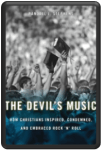 Randall J. Stephens is Reader and Associate Professor of History and American Studies at Northumbria University in northeast England. In his most recent book,
 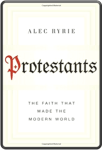 Alec Ryrie is a professor in the Department of Theology and Religion at Durham University in northeast England, and an ordained minister in the Anglican Church. His most recent book,
 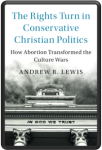 Andrew R. Lewis is Assistant Professor of Political Science at the University of Cincinnati. His book,
 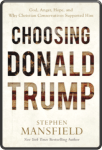 Stephen Mansfield is a historian, speaker, and best-selling author of books about George Whitefield, Booker T. Washington, Abraham Lincoln, Winston Churchill, George W. Bush, and Barack Obama, among others. His latest book,
  Kurt Andersen is a distinguished author, editor, and social critic. A former editor of New York magazine and founder of Spy, Andersen is the co-founder and host of Studio 360 from Public Radio International. His writing has appeared in Time, Vanity Fair, The New Yorker, and The New York Times, among others. His new book,
  Michael J. Altman is Assistant Professor of Religious Studies at the University of Alabama. His book,
  Frances FitzGerald is a decorated journalist and historian. She is a recipient of the Bancroft Prize, the Pulitzer Prize, and the National Book Award. Over the past five decades, her work has appeared in the New Yorker, the New York Review of Books, and The Nation, among many others. Her latest book,
  Emily Esfahani Smith is a columnist for