
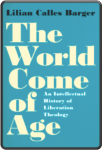
 Lilian Calles Barger is an independent historian, speaker, and podcast host. In her new book, The World Come of Age: An Intellectual History of Liberation Theology, she traces the legacy of liberationism back to its initial rise in the latter half of the 20th century, situating it atop the prior movements and thinkers who paved the way. Her work is vital for understanding the potential for Christian Leftism in the Americas, both then and now.
ECM: In a nutshell, what is liberation theology?
LCB: Liberation theology is a radical theological and social movement that emerged in the late 1960s and 70s. It is a product of the political radicalization of that era. Its key ideas have a much longer history which I have attempted to trace.
ECM: You situate liberation theology as part of a shift from transcendence to immanence within theology writ large. What do you mean by that?
LCB: The tension between transcendence and immanence has been at work in theology for a very long time. At certain points, God has been imagined as a distant, otherworldly figure, while at others, God has been very much an interventionist in human affairs. With the social gospel in the early twentieth century, theologians began to swing decisively in the latter direction, emphasizing a God at work in the everyday of every day. By the 1960s and 70s, liberationists were situating God, not simply among human beings on earth, but specifically among the poor and the oppressed, to advocate on their behalf. God was not only close at hand, but God was found among oppressed people in their struggle against oppression. This was a shift in the character of God from one who had equal universal regard to one who was partial to black people, the poor, and women.
ECM: How significant were Latin American theologians in affecting this shift?
LCB: They were critical. Liberation theology was an intellectual movement of the Americas, and Latin Americans played an enormous role. In part, this was because Catholicism was so prominent in those nations, and it was very hierarchical. The religious leadership had been very much removed from the people who had developed their own folk Catholicism. So these theologians were working with people in revolutionary situations—they were seeing the poverty, they were seeing the struggle—and they recognized that the theology they learned in Europe and the United States was too esoteric, too hierarchical, and too aloof to grapple with the situations they faced. They began to think about the differences between how theologians think about God and how people in shantytowns think about God. They were trying to capture the popular understanding of God and amplify that voice and give it legitimacy as theology.
Liberationists were active in base ecclesial communities and para-church groups where ordinary people read or heard biblical stories. The people would then express what those passages meant to them in their situation of oppression. One example is the well-known story of the Good Samaritan that becomes a story of oppression by elites and an example of solidarity between the Samaritan and the victim of violence. It is no longer a story of charity but of solidarity. Contact with the grass roots allowed liberation theologians to see the Bible through a different lens and to critique readings that assumed elite objectivity. The text was always political and its interpretation depended on who read it.
ECM: What about black thinkers in the United States?
LCB: There were many of them, but I focus in particular on James Cone. He was trained in modern theology at Garrett Theological Seminary, wrote a dissertation on Karl Barth, and emerged from a very European theological mold. When he graduated, the civil rights movement was ongoing, Black Power was emerging, and he came to think that his theological education could not speak to the black radicals who were rejecting African American churches. He also struggled with how to respond to criticism from Malcolm X, especially the claim that Christianity was a white man’s religion that would always keep black people in bondage. Cone recognized that black people were being oppressed, not only by political systems, but also by religion itself. He joined black pastors and other religious leaders who were calling for a black theology not dependent on white theological categories—one that would speak to and for black people in their freedom struggle. In his work, he tried to develop a fitting response to these problems. The product of this effort—in addition to a serious existential crisis for Cone—was a theology of Black Power.
Read the whole thing at Religion & Politics.
 Robert Hudson is a recognized Bob Dylan scholar, a member of the International Thomas Merton Society, and a veteran editor. In his
  Christopher C. Brittain is Dean of Divinity and Margaret E. Fleck Chair in Anglican Studies at Trinity College, University of Toronto. Andrew McKinnon is Senior Lecturer of Sociology at the University of Aberdeen. In their book,
  Alan Noble is Assistant Professor of English at Oklahoma Baptist University and editor-in-chief of Christ and Pop Culture. In his
  Rachel Held Evans is a New York Times best-selling author of four books, each covering changes and developments in her Christian faith. Her most recent,
  Matthew Bowman is Associate Professor of History at Henderson State University. In his new book,
  Though
  Jeremy David Engels is Sherwin Early Career Professor in the Rock Ethics Institute and Associate Professor of Communication Arts and Sciences at the Pennsylvania State University. (In the not too distant past, he served on my dissertation committee!) In his new book,
  John Fea is Professor and Chair of the Department of History at Messiah College. In his new book,
  Adam Laats is Professor in the Department of Teaching, Learning & Educational Leadership at the State University of New York at Binghamton. In his new book,
  Randall J. Stephens is Reader and Associate Professor of History and American Studies at Northumbria University in northeast England. In his most recent book,
  Alec Ryrie is a professor in the Department of Theology and Religion at Durham University in northeast England, and an ordained minister in the Anglican Church. His most recent book,
  Andrew R. Lewis is Assistant Professor of Political Science at the University of Cincinnati. His book,
  Stephen Mansfield is a historian, speaker, and best-selling author of books about George Whitefield, Booker T. Washington, Abraham Lincoln, Winston Churchill, George W. Bush, and Barack Obama, among others. His latest book,
  Kurt Andersen is a distinguished author, editor, and social critic. A former editor of New York magazine and founder of Spy, Andersen is the co-founder and host of Studio 360 from Public Radio International. His writing has appeared in Time, Vanity Fair, The New Yorker, and The New York Times, among others. His new book,
  Recommended Reading