
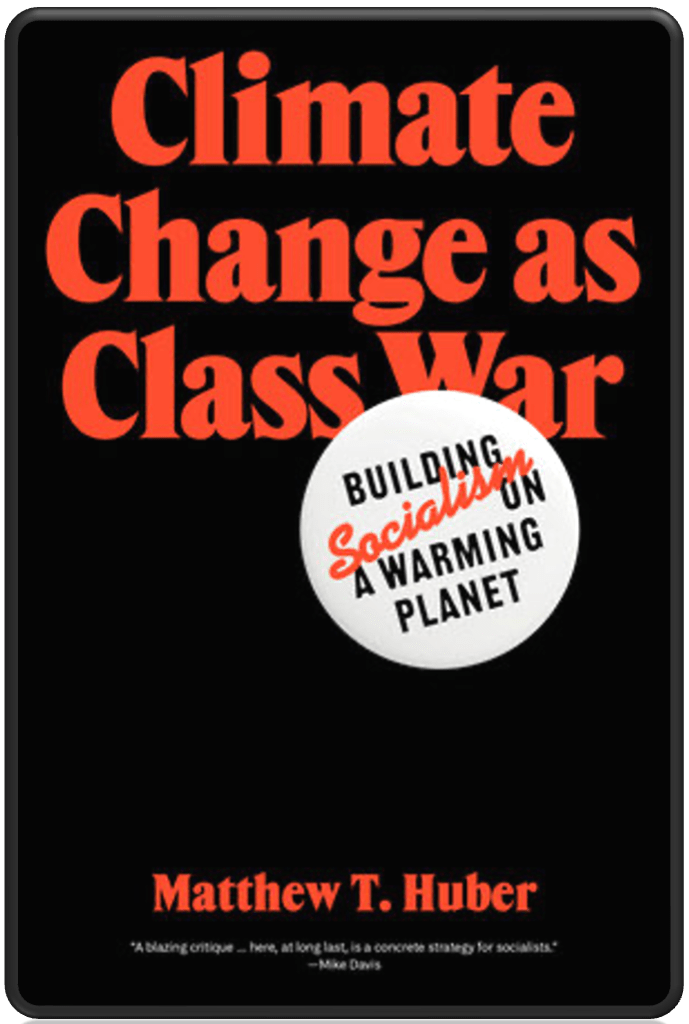
Matthew T. Huber is Professor of Geography at Syracuse University. His book, Climate Change as Class War: Building Socialism on a Warming Planet, advocates a working class approach that might mobilize a majority of American citizens. For Huber, degrowth pitches an unappealing politics of less to people who survive on too little already.
Matthew T. Huber’s Climate Change as Class War shares some fascinating insights prior to reaching some unsatisfying conclusions. In that sense, his argument serves as a representative anecdote for so many titles in the contemporary climate literature—an incisive critique both of the status quo and the leading alternatives, supplemented by an also improbable set of proposals for action. It’s a roller coaster of a read. But perhaps this is the fate of any sincere effort to fight the climate crisis at this delayed stage in the struggle. Having put off the response for so long, the methods become less adequate as the demands become more urgent. Nothing seems practical because practically nothing can be.
First, to the critique. Huber arranges the book into three sections, each correspondent to one of the three classes relating, in some way, to the crisis. The first of these is the capitalist class, primarily responsible for climate change in that it features the executives, boards, and shareholders of powerful industries that emit the bulk of greenhouse gases. Members of this class are wealthy, powerful, relatively few in number, and they control the means of production. Because they benefit so handsomely from the way things are, they have little incentive to change.
The second is the professional class, comprised mostly of the knowledge workers who propel the information economy. More numerous than the capitalists, professionals are separated from the means of production, but enjoy a privileged position within the social strata and play a central role in the climate movement. Because they tend to be college graduates, professionals are persuaded by appeals to information and science. And because they typically perform comfortable jobs and make decent salaries, professionals are prone to feel guilty about their own material contribution to the crisis. Accordingly, their climate activism—which is to say, most climate activism—is reliant on data and focused more on reducing consumption than altering production.
The third is the working class, by far the largest group and an unrealized source of political power. Because they account for around 65% of the American population, workers are vital to any movement that seeks to create a majority coalition. Because they staff the industries that generate emissions, their collective bargaining and strike powers could enable them to control the means of production. And because their condition is generally defined by economic insecurity, workers have a basic interest in refashioning the nature of production into a cleaner, healthier, and more equitable form. Still, that economic insecurity is a barrier to concerted working class climate action because it focuses energy on more immediate concerns. To paraphrase the French Yellow Vest movement, you can’t worry so much about the end of the world when you’re too busy worrying about the end of the month.
Huber’s class frame is illuminating, and may be especially so for his professional class readership. Anyone who went to college, is persuaded by graphs, and feels routinely aggravated by climate apathy or denial will find helpful context here. Political power is a numbers game, and the climate movement cannot hope to win majorities if it doesn’t tailor arguments to the largest audiences or appeal to those voters’ material needs. A professional class climate movement that crafts arguments for itself is preaching very directly to the choir. Huber identifies an urgent and obvious need for a working-class climate advocacy, and for a class struggle targeting the means of production en route to a greener and more equitable distribution of wealth. These are all strengths of the argument.
The primary weakness, in my view, is that Huber needlessly attacks professional class movements, largely dismissing some of those most likely to activate and drive his core readers. His casual dismissal of the Citizens’ Climate Lobby—one of the nation’s most active climate groups, for which I have served as a chapter leader since 2019—is entirely unnecessary and counterproductive. In the CCL, Huber argues, we have a prime example of professional class advocacy that, in its attempt to create a bipartisan climate coalition, simply “cedes politics to the right.” Its primary policy goal, a carbon fee and dividend, is “a right-leaning ‘free market’ solution,” and its failure to pass such legislation in the United States shows that the organization “has failed” (139-141). There is a lot to unpack here.
It’s certainly true that, in attempting to persuade elected Republicans, the CCL does try to find policy angles that might appeal to them, including those that harness market mechanisms rather than regulation. It’s also true that a carbon pricing bill has not passed in the United States, despite the best efforts of CCL advocates (including my frustrate self). But the organization is interested in other policy ideas as well, and many of the other bills they have endorsed and lobbied for have passed through Congress and become law. They have done so with the support of citizen volunteers using letters to the editor, phone calls to their representatives, tabling events, lobby meetings, and local chapter gatherings to try to influence the political process. The entire enterprise is about as wholesome and American as they come, and should warm the heart of every high school civics teacher.
And importantly, there is quite a bit more traction and public buy-in for these methods than for proletarian revolution. If the implementation of key goals is the metric for success, then Huber’s preferred method has been an abject failure as well.
His critique of degrowth makes these same mistakes. Again, Huber dismisses degrowth advocacy as a professional, academic movement too concerned with data and policy rather than class struggle. He writes that degrowth’s emphasis on downscaling harmful industries in the global north “territorializes” what ought to be an exercise in global solidarity. He argues that degrowth ideas are too localized, and do not adequately account for large-scale industrial change. And above all, Huber claims that any “politics of less” is a “bad strategy” (162-175). His point that working class people are already living with less is well-taken.
But his position is weird because his goals are so largely congruent with those in the degrowth platform. Both are urgently concerned with the climate crisis. Both identify capitalism as its cause and driver. Both hope to reorient global commodity production in more sustainable ways. And both draw on Marxist analyses to frame their critiques and design solutions. But instead of an alliance, Huber works hard to create a division, as though left movements don’t already have enough of those.
It’s also worth noting here that, in dismissing degrowth’s too academic-y data, he does not actually engage with any of it. So while prominent degrowthers have argued articulately that degrowing the economy is crucial to any concerted climate response—citing rates of emissions, material extraction, violation of planetary boundaries, etc—Huber simply ignores all of this in favor of a focus on politics alone. It’s fine if he thinks that degrowth is politically unviable. But that does not make it physically unnecessary, and it would interesting to see how Huber grapples with the difference.
In the end, having spurned professional class climate advocates in some of the world’s most promising movements—and likely the majority of his own readers—Huber argues, instead, for a working-class climate movement built out from labor unions, and especially those working in electricity. If the revolution is improbable globally, he shrugs, it is at least feasible in a handful of unions based in one important sector. (Huber concedes that these unions tend to be politically conservative, but never mind.) When his students ask him what they can do to help fight climate change, Huber quips, he tells them to “join a union” (281).
That’s all well and good, and it seems unlikely that many climate advocates would object to such a strategy. But for those of us bound to continue our work in the professional class, already serving, perhaps, in our white-collar unions, this leaves little for us to contribute. Readers may be forgiven for concluding that we are irrelevant in any case. I don’t see why this book couldn’t advocate for a professional-working class alliance of sorts, pitting the enormous majority against the capitalist class in a struggle for a brighter future in common. I don’t understand why it is so important to draw sharp lines of demarcation between people and movements that are working toward shared goals. But read enough books in this area and you will find that such lines are central to every case. To me it seems clear enough that the climate crisis requires everything from everyone, working on parallel tracks, using different methods to reach different audiences, and nudging us all in a better direction in a race against the clock when every fraction of a degree counts.

 Recommended Reading