
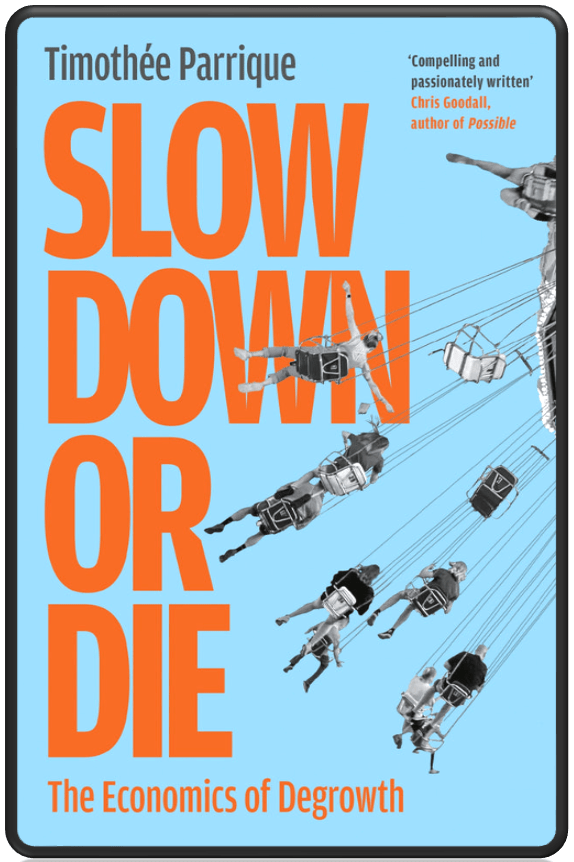
Timothée Parrique is an economist and a researcher at the University of Lausanne. His book, Slow Down or Die: The Economics of Degrowth, provides an exhaustive account of degrowth economics — its origins, history, policy proposals, influence, common critiques, and vision for the future.
“Green growth, circular growth, inclusive growth, blue growth; fifty shades of growth but always growth.” So Timothée Parrique characterizes the economic discourse early in Slow Down or Die, the English adaptation of his 2019 doctoral thesis at Université Clermont Auvergne. Now nearly a century removed from the development of GDP as the primary economic metric, world economies continue to pursue ever greater growth to the exclusion of all other considerations, and despite the obvious emergence of countervailing ecological and ethical impacts. The growth imperative informing all capitalist economies — defined by its persistent investment of capital to generate profits which are then reinvested to generate more profits ad infinitum — has come to menace the natural world on which those economies are based. Refashioned as “natural resources,” the ecosystems of which we are a part and on which we rely are relentlessly looted by an economic metabolism that extracts, refines, manufactures, markets, sells, ships, consumes, and disposes of every commodity it can manage to produce, animated by a fossil-fueled energy apparatus that emits greenhouse gases all the while.
Though scientists suggest that human sustainability demands an atmospheric carbon concentration of 350 ppm or less, we passed that threshold around 1990, and today operate around 425 ppm and rising. This growing existential threat is closely correlated with growing economic output, especially in the global north. That relationship is fundamental to all degrowth argument.
At least since the Great Depression, the conventional economic wisdom has suggested that growth is good, and greater growth is better, and that nations may assess their economic performance through clear statistical measures that pit their growth against that of other nations. One important implication of this trend is that people come to think of growth and its pursuit as essential to humanness, as corollary to our human nature. It is to this mistaken belief that Parrique responds. “We must free ourselves from the ‘mystique of growth,'” he writes, “meaning we need to denaturalize economic growth as a phenomenon.” Indeed, “growth is not a destiny but a choice.”
If that is true, then the spiraling relationship between economic output and environmental damage need not lead irresistibly toward catastrophe, either for us or the other living beings that inhabit this planet. Instead, Parrique argues, we can “imagine degrowth as a transition toward a post-growth economy.” In other words, we may pursue “a downscaling of production and consumption to reduce ecological footprints, planned democratically in a way that is equitable while securing well-being,” hoping ultimately to create “a steady-state economy in harmony with nature where decisions are made collectively and wealth is equitably shared, allowing us to prosper without growth.”
No matter how this sentiment is phrased–and different degrowth writers will phrase it in subtly different words–it cannot escape a certain utopian ring. So it is worth stressing that such a world is no more utopian than the one we now inhabit, a world that believes it can continue burning itself up forever without suffering the consequences of that neglect–a world that persists stubbornly in this belief, all evidence to the contrary.
Having told the story of GDP from its inception in the mind of Simon Kuznets, Parrique considers its application today, in an economic context far too large and too complicated to tolerate basic questions about its nature, mechanism, and purpose. He breaks economic activity down into five parts: extraction, whereby resources are pulled from nature; production, whereby they are transformed into a product; allocation, whereby they are transferred via donation, distribution, or sale; consumption, whereby they are used; and elimination, whereby they are disposed as waste. Understood in these terms, an economy exists “to satisfy needs in the broadest sense of the word, that is, everything a community could possibly want, whether essential or superficial.” An economy is “a means, not an end.” And the purpose of an economy “should be to advance our ‘capabilities for flourishing,’ to improve our quality of life, our existence.” An attempt at “economic efficiency” should serve the achievement of “economic sufficiency,” providing all people with the things they need to flourish.
But the economy we have doesn’t really abide these directives. Instead, it privileges growth for its own sake, as a means to funnel ever greater returns to the investors, directors, and managers who have long horded the bulk of that revenue to begin with, so that they can reinvest that money to generate more money still. The fruit of this labor has blossomed into dramatic and steadily increasing global inequality, expressed as generational wealth and expansive political power for a microscopic ruling class and a mix of hobbled prosperity or actual poverty for billions of others, against a backdrop of ecological crisis. The claim that selfish incentives pursued by elites will benefit entire communities has fallen into disrepute, and rising sea levels have not risen all boats. An urgent change is needed.
Parrique’s book is more thorough than most in its attention to the history of degrowth ideas, the ecological, social, and political limits that they respect, the transition pathway they would blaze, and the diverse critiques to which they must respond. Indeed, the book does feature a certain dissertation-ish quality in its focus on these matters, but remains very readable nonetheless. Parrique himself comes across as a playful figure, despite the severity of his subject matter, and his writing is conversational in tone. His arguments are compelling, his sources strong, and his personality inviting. Though Hickel’s book remains the gold standard in public-facing degrowth literature, Parrique has emerged in a close second.

 Recommended Reading