
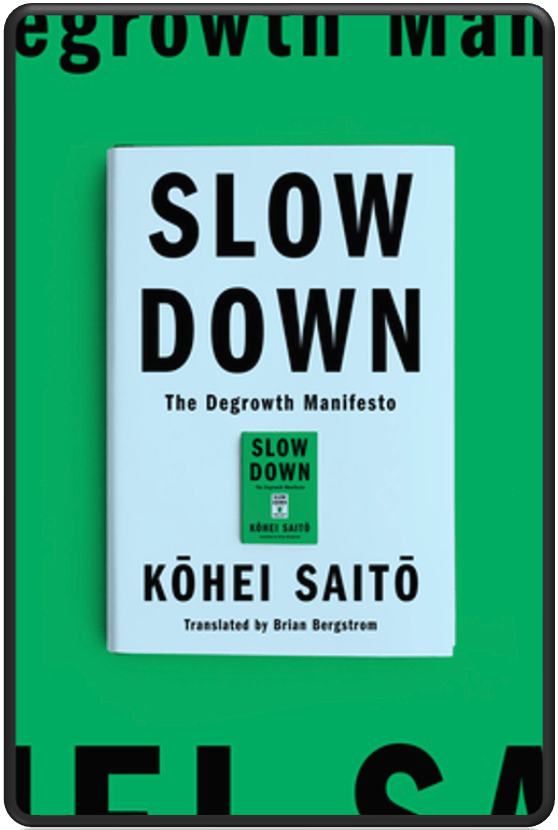
Kōhei Saitō is Associate Professor of Philosophy at the University of Tokyo. His book, Slow Down: The Degrowth Manifesto, was published in 2020, with the first English edition appearing in 2024. In it, Saitō draws primarily on Marx’s later work to argue for what he calls degrowth communism.
In his Slow Down: The Degrowth Manifesto, Japanese Marxist Kōhei Saitō connects capitalism to climate crisis in terms consistent with Hickel, relying also on Moore’s historical timeline. He, too, argues that capitalism must be understood against five centuries of development, and that the range of ecological and ethical impacts must be attributed to economic forces pursuant to ever greater returns on capital. But what makes his work interesting—and potentially problematic—is that he draws so directly on Marx and advocates so explicitly for degrowth communism.
It may therefore be tempting to bypass Saitō for the time being, to dodge the complications that he is likely to introduce. But sooner or later any candid assessment of degrowth’s prospects in America must grapple with Marx and the obvious associations that a degrowth platform is likely to draw with big government, central planning, and communism—American devil terms all.
Like Moore, Hickel, and the others, Saitō grounds his work squarely in the physical realities of the ecological crisis. Though the political is undeniably relevant, it is the physical that must determine the nature and scope of any substantive response. That, perhaps, is the great paradox of climate change mitigation. Some approaches are politically possible but physically insufficient, while others are physically sufficient but politically impossible. Advocacy for any one approach is therefore vulnerable to criticism from one or the other flank. Because the physically insufficient cannot be made sufficient, it will be necessary to make the politically impossible possible. The question of whether that means realizing ecosocialism, degrowth communism, a “greener” capitalism, or some other political arrangement, divides those on the progressive left.
On this point Saitō is less flexible than most, even among a cohort of pretty inflexible people. Slow Down opens with the flippant declaration that “ecology is the opiate of the masses,” and that any steps taken by environmentally conscious individuals or groups amount to soothing drugs in an overheating world. Reducing your personal consumption, installing solar panels on your house, driving an electric car, and crafting an energy-efficient lifestyle may actually do more harm than good, he argues, if they lull you into a sense of personal sufficiency and leave the larger systems intact. If it concerns Saitō that this critique might discourage his ecologically conscious readers, there is no indication of that here.
Saitō is equally dismissive of much larger initiatives, like the Green New Deal proposals deliberated in the United States and Europe in recent years. Insofar as these contribute to continued economic growth, even when centered upon goods like renewable energy, building efficiency, electrification, and conservation, Saitō can see nothing but capitalist excess. The critique of the GND in Slow Down provides a vehicle for his appraisal of related concepts like green growth, decoupling, techno-optimism, etc. The points he makes here are not dissimilar to those made in other degrowth volumes. But Saitō is unique in how closely he aligns these with the GNDs, those representatives of a policy array both aggressive and pragmatic enough to walk the line between sufficiency and possibility. While others, like Max Aji’s A People’s Green New Deal, refer to a sort of graduated scale of GNDS, Saitō just rejects them all. Here, too, he is all-too-quick to disdain concerted action taken by well-intentioned people in pursuit of goals that he supports, if they stop somewhere short of full communism.
Still, it’s not for nothing that Saitō insists that nothing else will work. Degrowth writers always clear the field of alternatives before pivoting to the positive case for degrowth. Hickel, for example, leans into emissions and material extraction charts to show that continued growth is simply not feasible, and so any model that presumes continued growth is dead on arrival. Though it might be politically attractive to make concessions to capital here or there, these are not physically workable, and that’s a red line. But while Hickel remains open to ecosocialism broadly conceived, or at least doesn’t explicitly close the door on every option, for Saitō it’s doctrinaire Marxism or sheer futility. That’s the choice.
The frustrating thing about this ultimatum, especially trailing a blanket disavowal of all individual and most collective action, is that it leaves us grasping for an even less marketable form of degrowth, and the alternative is destruction. It’s hard to see how this extreme black-and-white absolutism, presented with no tangible plan of action, is anything other than a patent nonstarter. Read in conversation with some of the other books, it helps to contextualize and understand some of the key terms and concepts. But it doesn’t exactly transcend them.
For degrowth to succeed in the United States, it needs to establish an historical legacy that ties its methods to a defensible strain of Americanness. The New Deal, for example, successfully implemented sweeping federal programs to counter an urgent national crisis, which explains why the Green New Deal polled so well prior to being savaged by a concerted right-wing propaganda campaign. It’s that legacy that makes the GND such a vitally important component of the American response to climate change. And because climate change is a problem of degrees, such dramatic shifts in the American economy can produce significant long-term benefits even if they are not immediately everything. To dismiss the GND is to make the perfect the enemy of the good.

 Recommended Reading