
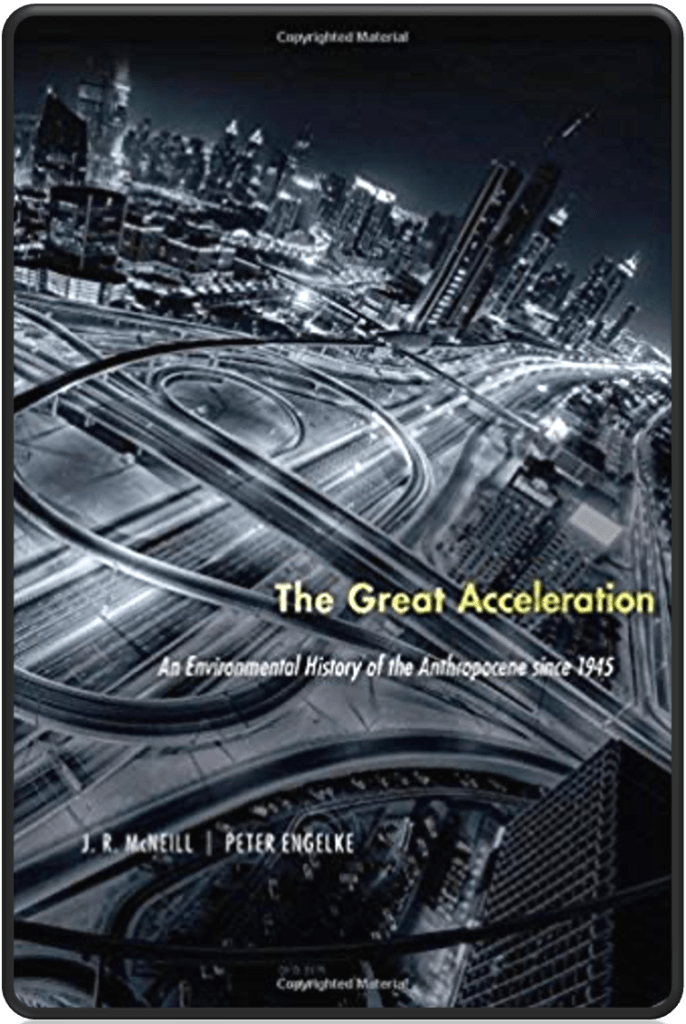
John R. McNeill is Distinguished University Professor of History and Foreign Service at Georgetown University. Peter Engelke is Senior Fellow with the Atlantic Council’s Snowcroft Center for Strategy and Security. In their 2014 book, The Great Acceleration: A History of the Anthropocene Since 1945, McNeill and Engelke trace the rapid increase in human production, consumption, and environmental impacts since World War II.
Because degrowth presumes a coordinated braking and reversal of economic growth, and because economic growth is an inherently human enterprise, any discussion of degrowth must be squarely grounded in a narrative history of the “human activity” that has so profoundly affected the biosphere up to and including our time on earth. Though an assortment of such histories exists, two frames have come to dominate the pertinent discourses. These are the Anthropocene and the Great Acceleration. Many scholars distinguish each from the other. JR McNeill and Peter Engelke fuse them into one.
Generally attributed to the Nobel Laureate Paul Crutzen, the Anthropocene denotes a new geological epoch, a successor to the Holocene, defined by the many and diverse ways that humanity have altered the physical composition of the planet. It suggests that, eons from now, some curious band of alien geologists could land on earth, dig down into the strata, and identify a layer infused with the calling cards of human existence—microplastics, circuit boards, packing peanuts, or whatever else, and air bubbles disclosing an atmospheric carbon concentration north of 425 ppm. Then any reasonable being would conclude that this stratum marked the human epoch in global history, as there would be simply nothing else to call it. Crutzen proposed that the Anthropocene be dated to the beginning of the 19th century, around the time of the first steam engines, though others have pushed the start date back or pulled it forward, depending on which inputs they want to emphasize.
(In 2009, the International Commission on Stratigraphy convened the “Anthropocene Working Group” to make a recommendation on whether or not a new geologic epoch ought to be declared. The AWS worked on the matter for a full decade before voting, in 2019, to recommend the change. The ICS then voted to reject that recommendation in 2024. Following the vote, AWS members led by Jan Zalasiewicz published an article in Nature arguing that, official or not, the concept of the Anthropocene is by now both entrenched and useful for thinking about the human predicament.)
For their part, McNeill and Engelke prefer a more recent vintage, launching the epoch immediately after the end of World War II, correspondent to historic changes in a host of important socioeconomic and earth system trends. McNeill was part of a working group that first coined the term Great Acceleration back in 2005—a group that included both Crutzen and Will Steffen, who went on to do some of the most influential work on the concept. Each of these scholars has argued, both emphatically and persuasively, that the world we live in today is not the world we lived in when FDR was president. Indeed, things have changed so much and so rapidly that the past eight decades deserve recognition as the most anomalous period since homo sapiens first fashioned tools. In many ways, the changes have made human life better—at least for some humans, in certain parts of the world. But the tradeoffs have been brutal and the impacts are becoming more severe with each passing year.
Most obviously, brisk increases in socioeconomic trends like global population, gross domestic product, primary energy use, and others are directly attributable to increases in fossil fuel consumption, and facilitated by an unprecedented buildout of industrial infrastructure that was then quickly repurposed from munitions to commodities. The concentrated mobilization that had fired the war effort in the United States did not vanish upon the declaration of peace, but instead turned its formidable powers to the cultivation of postwar prosperity by way of consumer capitalism. The wide array of new products, including carbon-intensive options like electrical gadgets, the family automobile, accessible air travel, and abundant food from mechanized agriculture changed the physical world even as it changed human life. The global population, which had taken about 200 millennia to reach 2.5 billion in 1945, then tripled over the next eight decades. Global GDP rose from about $2.5 trillion to approximately $115 trillion, an increase of 4500%. Approximately 90% of all the carbon dioxide in the atmosphere today has been emitted since the end of World War II.
Consequently, the material benefits of the acceleration—including the computer on which I type and the electrified, climate-controlled room in which you read—have come at the cost of ecological impacts. Atmospheric carbon, which had been relatively stable for the previous million years, has climbed over 30% in the last eighty. The global surface temperature of the earth has risen nearly 1.5° over pre-industrial levels, and the rate of that increase has doubled since 1975. The oceans are now about 35% more acidic. And we continue to experience a biodiversity collapse that scientists call the world’s sixth mass extinction. By some estimates, global wildlife populations have decreased by almost three quarters since 1970.
Basically, over the last eighty years, an important subset of the human population have imposed themselves upon the planet with vigor, and the planet has born the physical burdens of that work. And because we live here, we must now carry them too, if unequally.
To their credit, McNeill and Engelke tell this story in about as dispassionate a way as possible. They report the changes and rates of change, they acknowledge the economic and technological achievements, and they establish the causal relationships between benefit and liability in each case. In the end, they conclude that, though the Anthropocene will continue on, the Great Acceleration is coming to an end. Population growth has already begun to slow, and economic growth will soon follow suit, if only because limited quantities of fossil fuel and the obvious impacts of burning it will soon disconnect the acceleration from its primary source of power.
On these points, McNeill and Engelke are likely correct, but their deterministic posture stops short of commenting on the pace of the coming change. Global elites are heavily invested in economic growth, and have for decades fought to ensure that fossil fuels continue to be burned and that the public continue to be misinformed about the effects of that burning. In prolonging the inevitable, they seek to profit from the suffering of the entire biosphere. Under these circumstances, the only logical response is to accelerate the deceleration—to degrow the problems that we face together.

 Recommended Reading