
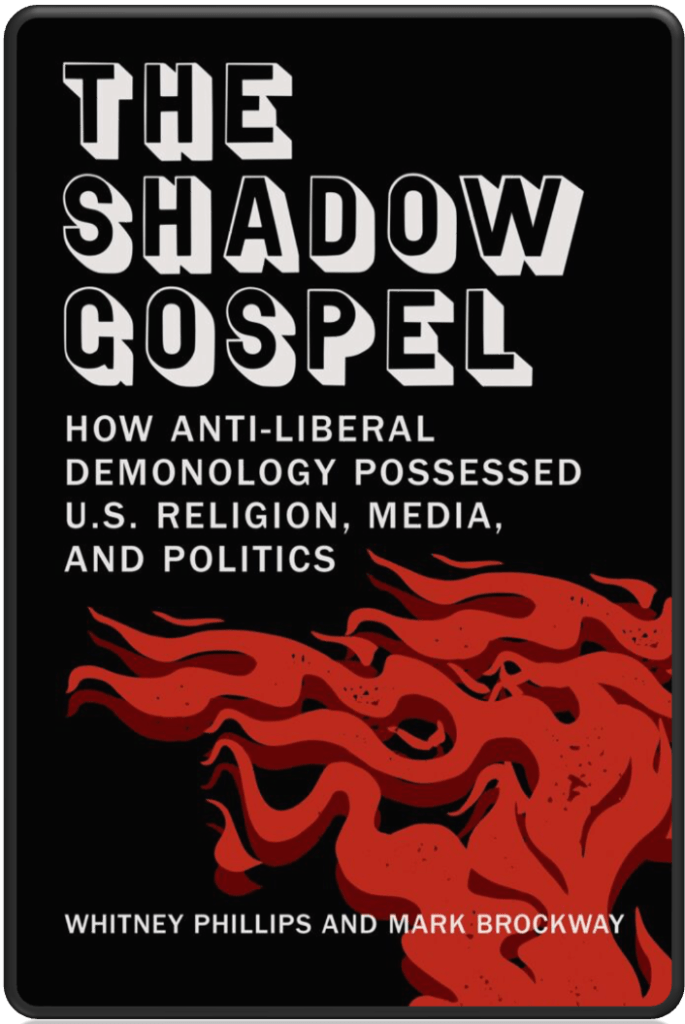
Whitney Phillips is Associate Professor of Information Politics and Media Ethics at the University of Oregon, and Mark Brockway is Assistant Teaching Professor of Political Science at Syracuse University. Their book, The Shadow Gospel: How Anti-Liberal Demonology Possessed U.S. Religion, Media, and Politics considers the persistent demonization of the “liberal” in right-wing discourse.
The most memorable claim in Eric Hoffer’s The True Believer (1951) is that “mass movements can rise and spread without belief in a god, but never without a belief in a devil.” There is no social force more unifying or mobilizing than shared hostility toward a common enemy, and no social movement that has not rallied in one way or another around such hostility. In some cases, like the Civil Rights movement, moral force is drawn from restraint, as members confront the enemy by submitting to its violence, self-consciously meeting hatred with love and performing citizenship through sacrifice. In others, like the contemporary MAGA movement, hatred courses outward through conspiracy theories, sinister allegations, and official malice, limited only by the bounds of an exceptionally creative group imagination. But if these contrasts mark a wide difference in degree, they do not quite constitute a difference in kind. It’s just a question of how the enemy is envisioned and engaged.
In their book, The Shadow Gospel: How Anti-Liberal Demonology Possessed U.S. Religion, Media, and Politics, Whitney Phillips and Mark Brockway provide a religious backstory for this strange political moment, tracing the rhetorical contours of American Christian Rightism back across more than eight formative decades, from the rise of the neo-evangelicals around 1940 to the political resurrection of Donald Trump in 2024. Though we tend to frame our politics in terms of “division” and “polarization,” Phillips and Brockway disclaim these as vagaries. Instead, they argue, the United States is today most clearly defined by the opposition between a powerful cohort of reactionary Christians and the “liberal” demons that they work to defeat at all costs.
If this seems a too-narrow lens through which to view a nationalized culture in one of the world’s largest and most diverse nations, the authors counter that liberal demonology operates now upon a deep tradition and across a broad sphere of influence. Though undeniably marginal at the end of World War II, the evangelicals made rapid in-roads into American culture over the decades that followed, enabled by their uniform whiteness, their self-conscious traditionalism, their obvious media savvy, and the fertile soil of a militant anti-communism that both valorized the evangelical profile and demonized the alleged scores of secret communist agents operating always in our midst. From these wide foundations arose a religious-political movement ostensibly committed to the beauty and truth of the gospel yet always more squarely focused, as a practical matter, on identifying and vilifying liberal demons.
Throughout their histories, organizations like the National Association of Evangelicals and Billy Graham’s Youth for Christ were oriented in opposition to the more liberal Christian mainline, casting its non-fundamentalist doctrinal stands alongside the menacing threat of a more liberal politics. (A notoriously slippery term, liberal does not mean exactly one thing in religion and politics, or indeed in politics alone.) Christians—and especially the young—were imagined as persistently vulnerable to worldly temptations like popular music, countercultural trends, sex, drugs, “modern” ideas, and communist influence, all of which served as conduits for Satanic action. The ascendant evangelical organizations of the postwar years were founded to mainstream a conservative Christian message able to counter these secular forces. They sought to practice spiritual warfare from the churches, communities, cities, and power centers of American life.
By the time Jerry Falwell convened the Moral Majority in 1979, the confluence of conservative Christianity with Republican politics was complete, and the new union was animated immediately by a crusading religious zeal. If the one faction had been occupied so far with the defeat of Satan and the other with the defeat of Democrats, the Reagan Revolution inaugurated a stage in which those parallel missions would be conjoined as one. Across his two terms, Reagan’s strong rhetorical condemnation of “godless communism” in the “evil empire” channeled much of that spiritual energy toward the USSR. When the Cold War ended abruptly in 1991, it circled back to the homefront, finding new hosts and targets via another Republican “revolution” in 1994.
From Newt Gingrich forward, the American rightwing would be increasingly defined by an aggressive and accusatory rhetorical posture, carried far and uncritically by an expansive media apparatus. Assisted first by Rush Limbaugh and, later, by Roger Ailes, the sweeping alliance between congressional Republicans and the new Christian Coalition would achieve a media coup with the rise of Fox News and its imitators. Broadcasting the new Gingrich vocabulary—he had instructed his members to describe Democrats with words like sick, selfish, radical, treasonous, and worse—this new religious-political-media union hoisted liberal demonizing to new strata of reach and ferocity. Then Barack Obama was elected in 2008, and the hysteria was cranked to eleven.
This admittedly perfunctory summary account does at least identify the contours of the anti-liberal trajectory, as well as its braiding of the three key spheres of influence imposing demonology on our eyes and ears around the clock today. Understood as a reflexively and emotionally anti-liberal outfit—as opposed to something more consistent with the Beatitudes, for example—the contemporary Christian Rightwing becomes intelligible as MAGA, the cult of Donald Trump. Though many recent books have sought to explain Trump-vangelicalism as a religious, political, and social force, few do so as persuasively as this. Many have asked how such a union is possible. By the end of this book, you wonder how it could possibly have been otherwise.
In my view The Shadow Gospel is somewhat over-written throughout, weighed down with a volume of references and citations that impede a smooth read through a compelling narrative. And because the shadow gospel itself is crowdsourced across many decades and many millions of people, it is often hard to pin down as a clear and cohesive concept. But you don’t really need a simple definition or obvious rhetorical boundaries to process how the liberal devil has come to dominate thought and speech on the American Right—or to assess the irreparable harms it has caused. Though a social movement can clearly function well enough without him, the country would benefit enormously if American evangelicals could find their way back to God.

 Recommended Reading