

Edward Bellamy was an American socialist author, activist, and journalist who wrote six novels in the second half of the nineteenth century. His most famous work, Looking Backward 2000-1887, inspired the formation of “Nationalist Clubs” throughout the country, each dedicated to a better way of life through nationalized industry and civic collaboration rather than competition.
Though quite arguably not a great novel, Edward Bellamy’s Looking Backward 2000-1887 was inarguably a very influential book, inspiring a social movement in its time and warranting subsequent editions for more than a century after its appearance. The story of Julian West, a young, blue-blooded Bostonian who goes to sleep in 1887 and awakens in 2000, Looking Backward offers both a critique of Gilded Age America and a sepia-toned vision of the socialist utopia to come. From the vantage of the 21st century, the story is notable for its ideas, its idealism, its naivete, its foresight, and its execution—for the things it got right, those it got wrong, and its willingness to dream of something better.
Were it not for Mark Twain and Charles Dudley Warner’s earlier, also less-than-brilliant effort, Bellamy’s critique of the Gilded Age in the United States might be definitive of the era. It laments the postwar rise and spread of economic inequality, exploitative labor practices, environmental degradation, and pervasive corruption, as well as their moral and spiritual analogues. Early on Bellamy compares late nineteenth century society to a stagecoach, pulled by people, driven by Hunger, and truly beneficial only to those happy few who get to ride on top while the rest suffer. This sorry state of affairs would be intelligible to the enlightened citizens of 2000 only if they understood two misconceptions carried by their predecessors: first, that they truly believed there was no viable alternative; and second, that the affluent people on top of the coach believed themselves cut from finer cloth and so deserving of their leisure at others’ expense. For these reasons, the reigning posture of the wealthy toward the rest was one of profound, unconscionable indifference.
The action begins one evening in May when West, who has trouble sleeping generally, retires to his silent, subterranean bedroom, surrounded by thick concrete walls but ventilated through a pipe to the surface. He sends his servant to retrieve the local mesmerist, who makes a special visit even though he is that very night preparing to move immediately to a distant city. Hours later, deep in hypnotic sleep, West’s home catches fire and burns down above him, presumably killing the servant and confining West within an unbroken and preservative slumber. His friends and family mourn his apparent death in the fire.
When he awakes, in 2000, the Boston that he knew is long gone, replaced by a much larger, but also much cleaner, more peaceful, and more harmonious city. The air is clear, the people are happy, and the social turmoil surrounding the “labor question” has long-since been resolved to everyone’s satisfaction. West’s new companion, Dr. Leete, is cheerful but also a little cagey. Understanding West’s unusual situation and vulnerability, he hopes to ease the young man into the new century gradually, revealing the developments little-by-little through conversation. His uncommonly beautiful daughter Edith—who, improbably, has the same name as West’s former fiancé—hovers on the periphery with a mysterious interest in her father’s guest.
Though a lot has changed over the past 113 years, the most significant shift has to do with the organization of the economy itself. Sometime around the turn of the 20th century, Dr. Leete explains, the corporate monopolies had become so large and so dominant that they threatened American democracy, so the people had them nationalized.
“Early in the last century,” he says, “the evolution was completed by the final consolidation of the entire capital of the nation. The industry and commerce of the country, ceasing to be conducted by a set of irresponsible corporations and syndicates of private persons at their caprice and for their profit, were entrusted to a single syndicate representing the people, to be conducted in the common interest for the common profit.”
Nationalization of industry was the key piece of Bellamy’s socialism, which he called “nationalism,” and which prompted the launch of dozens of “nationalist clubs” around the United States in the 1880s and 90s. Much of Dr. Leete’s narration is devoted to explaining how nationalized industry has proven less expensive, more efficient, and much more equally beneficial than private enterprise.
Though West assumes that this enormous change could have been won only through civil war and bloodshed, Dr. Leete assures him that it was an entirely peaceful transition—a move that, by clearly reordering the system of incentives, channeled human motivations in a revised direction and achieved something tantamount to an altered human nature. Not only does everyone in 2000 work together for the common good, but they are able to do so in career paths that they choose for themselves, for a shortened period of time, in pursuit of honor rather than wages. In fact, they live in a world without money entirely—also without poverty, politicians, standing armies, wars, or most other social ills. Instead, the Americans of 2000 have guided the military ethos—with its commitments to teamwork, sacrifice, duty, and honor—toward the maintenance of the state itself. This “industrial army” makes the wheels turn while drawing citizens together as peers in a shared enterprise.
And this, of course, is the point of Bellamy’s book. He uses a simple narrative framework to inject some entertainment value into what would otherwise be a political treatise. It works, but perhaps not so well that you forget what you’re reading. The sharp back-and-forth between West and Leete, crafted to interrogate key questions around Bellamy’s program, is an effective means to explain and analyze his remarkably detailed and thoughtful vision.
Bellamy is also wisely hesitant to describe the physical particulars of futuristic life in detail, quietly assuming instead that dress, speech, transportation, etc. are essentially similar to those of his own day. To me this sleight of hand becomes most obvious in his treatment of Edith, who moves and speaks much more like a 19th century romantic than any of the eighteen-year-old girls that I knew in 2000. With the benefit of hindsight, we know that her name probably would have been Sarah or Jessica or Ashley, she would have been listening to *Nsync, wearing low-rise jeans, driving a Dodge Neon, and probably not falling in love with the dusty relic that her Dad—who she would not call Father—found under the backyard during a home renovation. And yet the story does need a love interest, so we might let these hedges slide.
His narrative suggests that Bellamy believed—maybe hoped—that by 2000 the American people would have gotten their act together, dismissed the fat cats, killed capitalism, and built a truly free and equal nation, recognizing that alternatives do exist. In that regard, unfortunately, Looking Backward reads less like prophecy than satire, and the 21st century continues to feel essentially similar to the 19th.
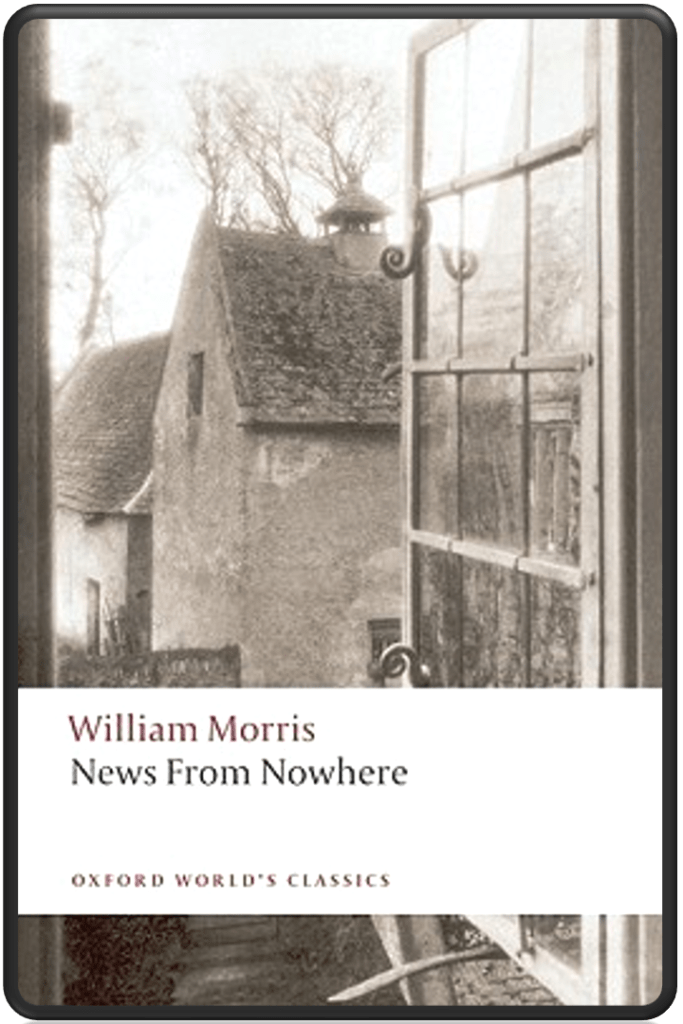
William Morris was an English socialist author, activist, artist, and designer who wrote his News From Nowhere in reply to Bellamy’s Looking Backward. A leading light of the Arts and Crafts movement, Morris countered Bellamy’s vision of mechanized state socialism with one devoted to productive, non-alienated craft labor.
William Morris’s News from Nowhere was authored in reply to Looking Backward. Morris had reviewed Bellamy’s book in the journal Commonweal in 1889, and began serializing his own project there in 1890. Based in London and renowned for this work with the Arts and Crafts movement, Morris offered a British counterpart to Bellamy’s American vision, as well as an alternative form of socialism. In particular, Morris objected to Bellamy’s overtly industrial future.
“The underlying vice in [Looking Backward] is that the author cannot conceive of anything else than the machinery of society,” he wrote. “The result is that though he tells us every man is free to choose his occupation and that work is no burden to anyone, the impression which he produces is that of a huge standing army, tightly drilled, compelled by some mysterious fate to unceasing anxiety for the production of wares to satisfy every caprice, however wasteful and absurd, that may cast up amongst them.”
Dismissive of a factory-powered world in which the workers work as before but control the means of production, Morris imagined an idyllic future in which a few large corporations had been replaced by a host of small artisans; in which assembly line uniformity had been replaced by handicraft. Above all, the citizens of his England would no longer be alienated from their labor.
In News from Nowhere, once again, the protagonist falls asleep in one era and awakens in another, a convention that Morris honors even though he dismissed it as cliché in his review of Bellamy. This time Julian West is William Guest, and Boston is London. The year is not specified, but occasionally the characters reflect on events from the early 21st century. Once again there is no money, no politics, no war, no poverty, and criminality has been essentially vanquished, sporadic crimes of passion notwithstanding. Once again our hero is guided by sensible men and uncommonly beautiful women.
But there are two key differences. First is that, while Bellamy treats work as a necessary evil, reducing each citizen’s obligation to a 24-year period between ages 21 and 45, Morris places work at the core of human purpose, provided each human is free to follow his own creative genius, and slowly. The people of Morris’s utopia work because they want to, because they enjoy it, because they are able to contribute what they want and to be motivated by the contribution they make to their society. No longer driven to long hours at hard labor by incentives like profit accumulation or status competition, they are free to live and work together amicably, equally, and happily.
The second is that, while Bellamy sets his story in an enormous futuristic Boston and remains city-centric, Morris takes Guest on a slow journey from a quaint and modest London to the North of England, traveling first by horse-drawn cart and then rowing up the Thames. (Morris makes no effort to imagine the transportation of the future, as that of the past serves his easy-going purposes.) Along the way, Guest encounters happy people laboring in the fields much as they did in the nineteenth century, but at a more leisurely pace and of their own volition. The setting shift allows News From Nowhere to cut a pastoral contrast to Bellamy’s urbanism.
Though the citizens of 21st century England seem to dress, speak, and act much like those of the nineteenth, they are different in a few important respects. The first is that they are much happier, a development that helps explain a second—they age much more slowly. Though we are told that Guest is 56, the people he meets are constantly mistaking him for a much older man, grizzled as he looks to their youthful eyes. The men of the future are fit and healthy, the women smooth and stunning. The gender roles have remained largely intact, but without any sort of compulsion. The women enjoy a sort of elevated status while continuing to do the things that women have traditionally done.
The one very notable exception to this traditionalism concerns relationships and family. In Morris’s England there is no legal marriage, and hence no contentious divorce. Guest is introduced early on to a man named Dick, who serves as his guide, and later to a woman named Clara, with whom Dick is in love and has two children. Clara had basically run out on Dick sometime in the past, having fallen in love with another man. But then she came back and the two of them remain in the reconciliation process as the action unfolds. While there are obviously emotional obstacles to overcome, there is nothing in the way of vindictiveness in their relationship. Through this strange bit of character development, Morris seems to suggest that relaxing these institutions somewhat would make everyone more harmonious, even in the messy hardships of love.
Ultimately, the future according to William Morris is formally comparable to that of Edward Bellamy, though with obvious content differences. One writer foresees a brighter world in which the workers have united to overthrow capitalism, the other a world in which the people have withdrawn from it entirely. One future is mechanized, the other decidedly not. One features freedom from work, the other embraces work as art. In both cases, the narrator wakes from the dream in the end, though Bellamy places his man in a dream within a dream, and has him wake from that. As it turns out, neither author was right about where things were headed, but perhaps that does not disqualify their efforts.
In fact, to read these works at this moment in time is to wish for more imaginative thinking about our future, more creative foresight about cultural and institutional changes that might fix the many problems we must negotiate day-to-day. It’s not that no one is thinking about next steps—it’s just that those who are seem to be following them onto inhuman trajectories. In Silicon Valley, the push is for AI that can replace us in many or most ways. In Washington, DC, the focus is on an idealized past that seems to recede ever further into a world of greater inequality, white supremacy, environmental destruction, and the rest. In that regard, the Trump years in the United States have been a prolonged exercise in looking backward, 2025-1887. Ours is a new Gilded Age, in which the enlightened citizens of the 21st century have looked back on a darker past, not with incredulity, but with nostalgia—or at least have entrusted their nation to people who do.
Therefore the time may be right for a new generation of utopian novels, written by human novelists, with a viable vision for a better human future. We need a bit of shaking, some institutional revisionism, a fresh perspective. In many ways we could be doing this thing much better. In some of the most important, we could hardly do worse.

 Recommended Reading