
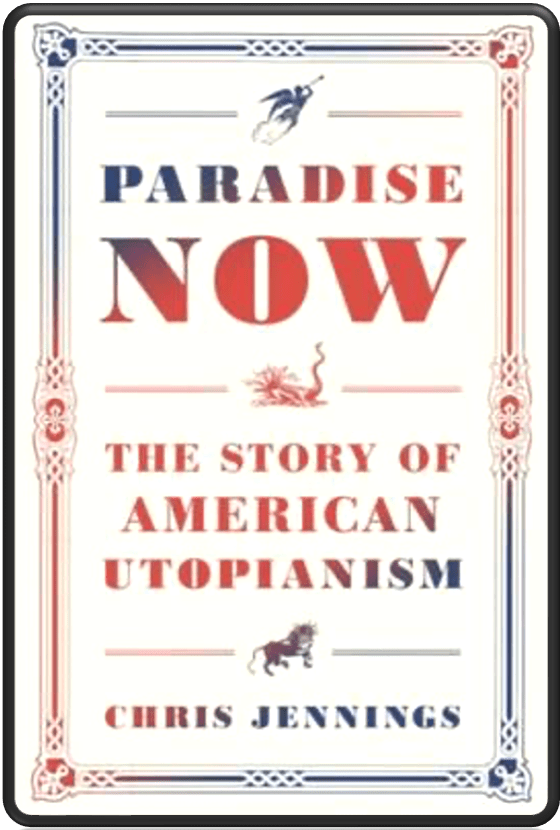
Chris Jennings is an historian and writer living in Northern California. His book, Paradise Now: The Story of American Utopianism, documents the experiences of five distinct and but related attempts at American communism around the middle of the nineteenth century. Valuable in themselves, these movements remain instructive for anyone who would work toward a better world.
During the first half of the nineteenth century—after the establishment of the American republic and prior to its dissolution into war—a diversity of homegrown utopians set out to found ideal societies across the land. Some of these were religious and doctrinaire, others secular and libidinous, still others a scandalous mixture of these qualities. But all believed that they could make the world anew, and better, through careful planning.
In his Paradise Now: The Story of American Utopianism, Chris Jennings focuses upon five examples: the Shakers, in New England; the Owenites, at New Harmony, Indiana; the Fourierist Phalanxes, including Brook Farm outside of Boston; the Icarians, of several places, like Illinois and Texas; and the Oneidans, in upstate New York. Though all of these experiments failed to achieve truly lasting success, they remain notable for making the attempt, and so demonstrating a faculty for imagination and will that seems to have died with them.
It is on this point, more than any other, that Jennings’ work resonates. Without detailing each group at length—though the book does so admirably—we can still appreciate the collaborative impulse at work throughout the land in those days. For all the attention fixed upon the self-cultivation and individualism of Jacksonian America, this was also a time of revolutionary creativity, when reformers formed societies and civilians civilized themselves in groups of the like-minded. It was a time before any pervasive will to make a name for oneself only, a time when we were still in this together. Nothing has been quite the same since.
So what happened? Jennings notes at least two formative influences at work. The first is that, prior to the Civil War, the adolescent republic was far less completely governed, and indeed far less governable than it would be afterward. The rapid expansion of the borders and consequent dilution of the population drove a frenetic federal effort to draw up territories, write rules, and establish order, but these goals were necessarily achieved—if achieved—on a delay, meaning that people were largely on their own in the meanwhile. In that kind of an environment, you look around for allies just to stay safe. And since the entire country seemed to be under construction, arising organically out of the state of—stolen— nature, new social organizations and arrangements seemed entirely plausible, especially when compared to alternatives like nothing at all. Further animated with the millenarian forces stirred by the Second Great Awakening, anything was possible.
The Civil War mostly ended this era, bringing that particular species of concerted optimism to a jarring close. Even an especially cheerful population will be chastened by violence and gore at that industrial scale; made to reflect a bit on what exactly dwells within the human heart and whether lion might realistically lay with lamb on any feasible time horizon. (Emancipation notwithstanding, the tribulations of the Reconstruction era and the corruptions of the Gilded Age did little to resuscitate much in the way of fellow feeling.) The utopians also saw their prospects shift beneath the rise of a powerful new Leviathan, a Washington-based central government of enormous new size and reach, now with unprecedented military might and expansive new administrative powers. From that point forward the state would run the show, and the independent, entrepreneurial spirt of the communes would be channeled instead toward politics.
The second influence emerges as a moral of the first, or rather as an interpretation of past practice that forecloses upon options yet to come. Across the board, the utopian movements failed, and so offered cautionary tales to subsequent generations of imitators or heirs. Because these attempts did not work, we have tended to conclude—perhaps blithely—that such attempts cannot work as a rule, and so have acclimated ourselves to the imperfect status quo. But one obvious benefit of Jenning’s detailed storytelling is that he clearly identifies and explains the various and often idiosyncratic causes that led to downfall in each case, demonstrating on the way that failure is not inherent or inevitable when people try to collaborate on better futures. Your odds improve dramatically, for example, if your visionary leaders aren’t more than a little mad, and if you resist the temptation to institute provocative new sexual arrangements. It would also be wise to recruit members with a diversity of valuable skill sets, and make sure you have a sustainable method of paying the bills. In the last analysis, the story of American utopianism might offer a preface to the later emergence of American pragmatism.
Though we tend to scoff at the utopians in hindsight, it seems worth recalling that all of them were successful for a while, and some more than others, and in the window of their success they believed they had it all or mostly figured out. If we can place ourselves in their shoes for a moment, we might see Oneida or New Harmony very much the way we see our own America now—as a not yet perfect but still striving society based in certain ideals and working hard to realize them in practice. In that light we may come to appreciate the modern United States, too, as a product of particular circumstances existing in a specific timeframe, and vulnerable as well to whatever awaits around the corner. Now at the end of the Great Acceleration, it is not difficult to foresee a world in which all of this looks rather utopian—a world in which we did whatever we wanted at whatever cost with little attention to the inequities and none at all to the impacts. A best-of-all-possible worlds, an eternal present, atop the never-breaking swell of progress.

 Recommended Reading